
Ploopy is different than many other electronics manufacturers in that we offer our supporters the option of purchasing a kit that they assemble themselves.
This is appealing to our supporters for many reasons. Some may want to learn about their products as they put them together. Some may want something to do over a weekend. And some love the savings.
It’s an option that our supporters enjoy, which is why we keep offering it. However, it comes with a bit of a downside. The most succinct way of putting it is this:
Shit happens.
Many things can and frequently do go wrong during the assembly process. For us, this isn’t that big of an issue, since we have spare parts, refined quality control processes, and lots of training. However, for our supporters who purchase kits, that might not be the case.
This blog post is about how we do quality control in our shop to ensure that we ship high-quality kits, and information about our warranty and how it benefits our supporters.
Our shop operates using the time-tested model of “continuous improvement”. That means that we continuously refine our processes to reduce mistakes and increase efficiency.
Here’s a good example. If you’ve received a parcel from us in the last year or so, it had a sticker on the outside that looks like this:
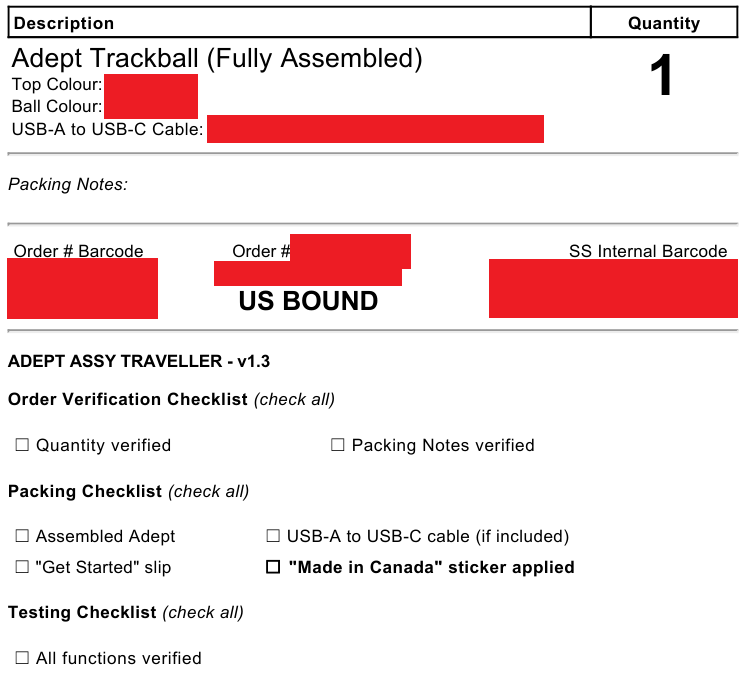
This sticker is called a “traveller”. It’s used as a checklist to help us figure out which parts to pick, which tests to run, and any custom steps needed to successfully fulfill this order. It’s on the outside of the box, which “travels” around the shop as the order is put together.
Now, here’s how “continuous improvement” comes into play. We used to use a different kind of traveler, one that was printed on different paper. It used to go inside the box. It made it difficult to see what was inside, since the paper had to be pulled out. And we couldn’t tell what was in the box when it was sealed.
Changing the traveller was a small but highly consequential improvement to how the shop operates.
Here’s a different example of continuous improvement. This is our electronics inspection and repair station:
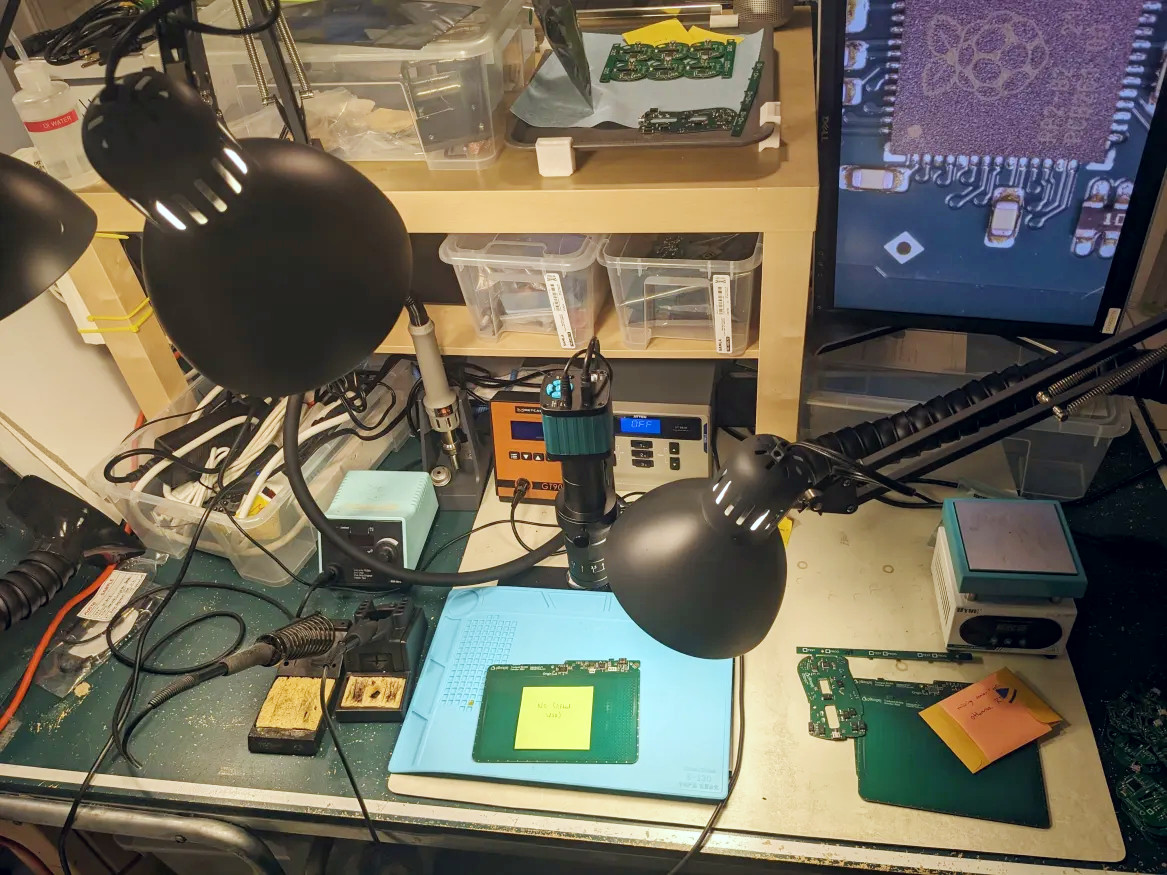
It’s got a high-quality microscope, multiple soldering irons, hot-air station, hot plate, and a large amount of consumables like solder braid, tape, and so forth.
This station took a long time to put together. We had to experiment to see what equipment was used most frequently. It also takes up a lot of space in our shop, which is small.
In this context, “continuous improvement” manifests differently: we actually don’t use this station very frequently.
We still use it occasionally – perhaps once every three months or so. It’s still worth having. But we’ve implemented so many improvements elsewhere in our electronics manufacturing process that we rarely produce electronics that require rework.
Both of these cases illustrate that our shop is continuously evolving, and that our quality control processes are getting tighter and tighter with each passing day.
This effort of continuous improvement extends everywhere, in places you wouldn’t even imagine. For example: I taped a piece of foam onto the corner of a piece of large equipment because a door kept banging into it. Now, no more dings.
As a result of our experience and our commitment to quality control and continuous improvement, we have an astoundingly low rework rate for the products that we ship out that are fully-assembled. Most weeks, it’s 0%. Zero!
That means, for most weeks, all of the products that we assemble pass their tests successfully without any need to change or fix anything after they’ve been completely assembled.
To be clear: even though our processes are continuously improving and our defect rate continues to drop, we fully test everything that we ship. If something leaves our shop on the way to one of our supporters, we have inspected it, tested it, and subjected it to rigourous standards of quality control.
Kits throw a bit of a problem into this plan.
Whether we ship kits or fully-assembled products, the parts that we use are picked from the same bins. That means, it doesn’t matter whether you get your order as a kit or fully assembled: it’s exactly the same parts. The only difference is that we assemble it for you, or you assemble it yourself.
So, the parts are the same, and based on our extremely low rework rate, we have strong evidence to support the notion that the individual components we produce are free from defects.
Workmanship is another matter altogether. We have lots of experience not just with electronics, but also with assembling our specific products. While many of our supporters are extremely skilled with electronics (frequently more skilled than we are), they never have more experience with assembling Ploopy products.
I will state this now so there is no ambiguity: we do not provide a warranty for work that we don’t do.
For our supporters who purchase kits, this creates an unfortunate reality: if the assembly process isn’t done correctly, we do not provide repairs, replacements parts, or refunds.
This is problematic. Very problematic.
There are several steps during assembly that are irreversible and have to be done correctly the first time, with no margin for mistakes. An obvious one is soldering.
If soldering is done incorrectly, then oftentimes the electronics are not salvageable, and the entire kit has to be thrown away. That’s a very bad experience for the people who support our shop.
This is why we work hard on providing high-quality build instructions, a help center, a support email service, and multiple online curated spaces for our supporters to exchange their experiences with one another.
In fact, we work just as hard to support those who purchase kits as we do on tightening up our internal quality control processes.
As I wrote earlier, our supporters who purchase kits buy kits for different reasons, whether that’s learning, or doing a fun activity, or getting significant savings. We’re able to provide these benefits to our supporters in exchange for our supporters pledging that they’re able to assemble their kits with a high level of skill.
The unfortunate reality is that we simply cannot sustainably operate our shop by providing warranty service for defects created by our supporters. We would love to do so because we enjoy engaging with our community, but if we did, we would only be able to do so for a short time before we had to shut our doors for good.
For our supporters who are on the fence about this, or think they aren’t able to do the assembly work at the requisite level of skill, we always offer fully-assembled products. It costs more, but it comes with a guarantee of a fully-working product, no matter what.
Our warranty is fairly standard in the electronics industry. I stand behind it, 100%. I believe that it’s a good middle ground between our shop and our supporters. It provides our supporters with good products and services, and keeps our shop running sustainably.
We have had, and will continue to have, customers who buy from us, make preventable errors when using our products, and become dissatisfied when we do not provide warranty service. They are a vanishingly small and vocal minority, but they exist. We regret that we cannot satisfy these customers.
For the rest of our supporters, our warranty is a fair representation of our responsibilities to our supporters – and our supporters’ responsibilities to our shop.
For many buyers, a company’s warranty is the most important part of their purchasing decisions. Many companies do nothing except what they’re contractually obligated to do, and nothing more.
People who judge our shop by that standard are likely to be disappointed, as our warranty does not materially differ from those of other companies.
However, I would argue that our products are far more than just our warranty. Our flexible purchasing options, our commitment to continuous improvement and quality control, our high-quality assembly instructions, our open-source design philosophy, our curation of online community spaces, and many, many other things go into making our products the best they can be for those who support our shop.
So, while it is true that our warranty service for those who support our shop may be limited, I firmly believe that we equitably and fairly support those who support us and our shop.